Surviving all-English meetings as a non-native speaker
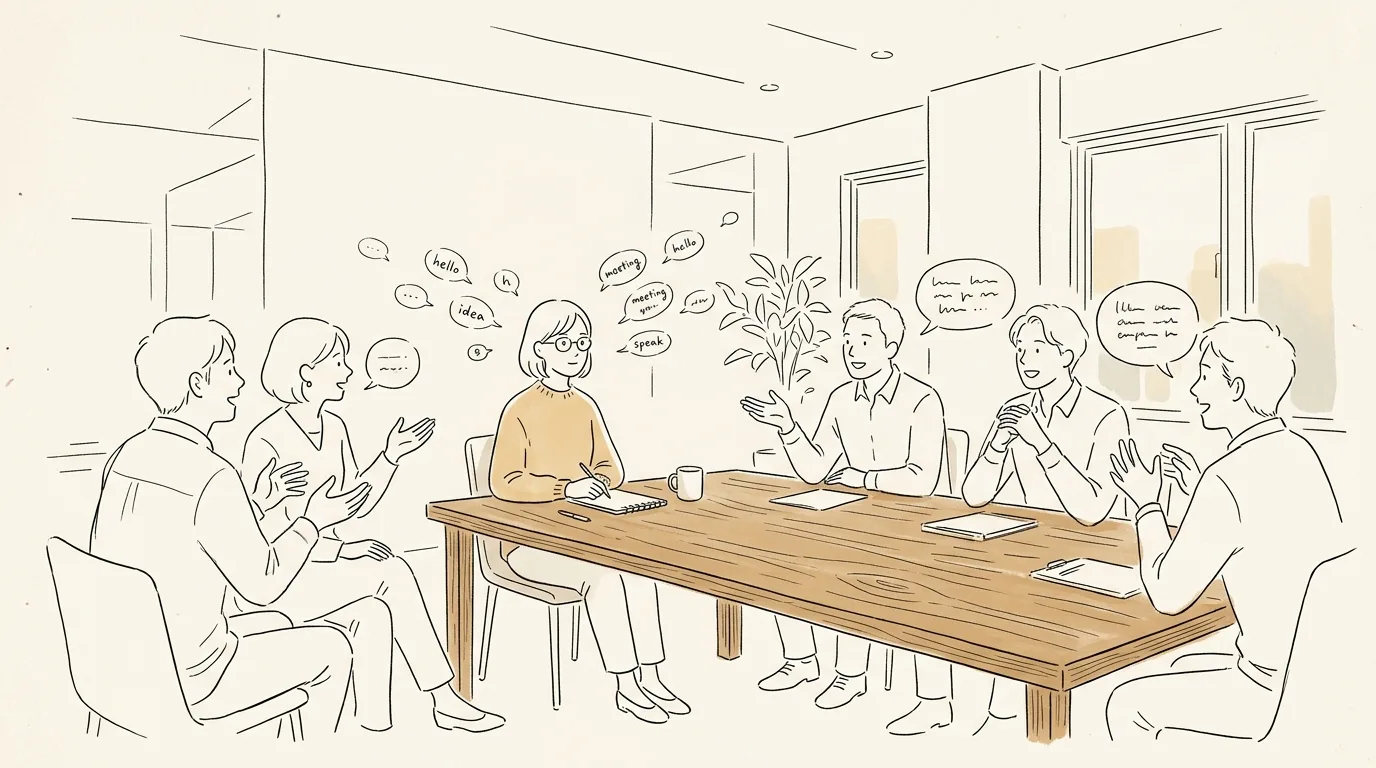
If you tense up a little before every all-English meeting, it isn't only about your English.
The room switches to English all at once, only the key points fly by, and while you're still timing your moment to speak, the agenda has already moved on. Feeling like you can't keep up in English meetings isn't a sign that you haven't tried hard enough. For a non-native English speaker, ESL meetings at work are simply the format that punishes you most — not your vocabulary.
I spent six months building Hiroi, a solo iOS app that fuses live translation with learning, and this is the situation people asked me about most. So I'll save the tool for last. Surviving all-English meetings really comes down to what you do before, during, and after — and here's what you can start today. One ground rule up front: you don't need to catch every word.
Why surviving all-English meetings feels so hard
It feels hard not because you don't know the words, but because it's real-time, with nowhere to hide.
- Miss one word and, while you're decoding it, the next two sentences are gone.
- Native-to-native speed, acronyms, and internal names can't be looked up at conversation pace.
- You're forced to listen, understand, and prepare to speak all at once.
So reframe it. Native speakers don't track every word either. What capable people actually do is catch the key points and fill the rest in from context. Just lowering your target from everything to the essentials takes the tension out of your shoulders.
Before the meeting — load the vocabulary that repeats
The saving grace of corporate meetings is that the vocabulary repeats. Same project, same client, same industry — the words that come up are largely fixed. So your prep isn't "English" in general; it's this meeting's vocabulary.
- Skim the agenda or last meeting's notes and pull just five to ten likely names and technical terms.
- Prepare the one or two points you want to make, in short English (keywords are enough — it doesn't need to be a perfect sentence).
- If it's a recurring meeting, look back at the words you couldn't catch last time.
Even five minutes of prep cuts down the brand-new-word moments on the day and leaves your brain some room to process.
During the meeting — four things to catch, and one phrase to confirm
Catch these four
The conclusion, the numbers, the names, and the next action. Hold those four and the skeleton of the discussion stays intact; the details you can pick up later. Everything else, you're allowed to let wash past. I wrote about this way of catching in more detail in the piece on not being able to follow English meetings.
If you didn't get it, confirm — that's allowed
Confirming out loud looks more professional than nodding along to something you missed. Keep a couple of short, memorizable phrases ready:
- "Let me make sure I got that — you mean …?"
- "Could you say that one more time?"
- "So the next step is …, is that right?"
Confirming isn't weakness; it's the work of getting everyone on the same page. A meeting isn't a listening exam.
Use live captions as training wheels
If all your attention goes into hearing, you have nothing left for thinking. Put a real-time translation caption beside you and your eyes can catch the word your ears slipped on, freeing your brain for understanding and for planning what to say. It isn't cheating — it's the same as having an interpreter next to you. One condition: captions that appear after the speaker finishes are too late. At meeting tempo you need them while the person is still talking, or you fall behind anyway.
After the meeting — turn the words that got away into study material
This is where the real difference is. What builds a version of you who can keep up isn't a trick on the day — it's what you do with the one word that slipped past.
Free translation understands the moment and then forgets it. But the word you missed today will come back — same client, same account, the vocabulary always repeats. So if you turn that word into today's study material, next time it won't get past you.
- After the meeting, keep just a handful of words you missed or want to reuse.
- Review them with spaced repetition (FSRS) — it quizzes you right as you're about to forget, so it sticks in far fewer reps.
- When one of those words turns up in a real conversation, the dots connect: "oh — that's the one I studied."
I've written up the flow of learning words straight from conversations in this piece on learning from conversations. Once that loop — catch → learn → meet again — starts turning, the meeting itself becomes your personal textbook. The meeting you survive today makes the next one easier. That's the most reliable shortcut there is.
Hiroi folds this whole flow into one place
You can do all of the above with a paper notebook. The trouble is that taking notes and building review cards mid-meeting never lasts. Hiroi folds it into one flow:
- In the moment: live captions for Japanese, English, and Chinese — streaming as people speak.
- Catch: save a word you want to keep with one tap.
- Learn: saved words go into an FSRS deck; review arrives right before you'd forget.
- Meet again: when a learned word resurfaces in real life, the app quietly tells you.
Two modes: Listen, which folds the room into a single language you follow, and Face-to-Face, a split screen for two. It never records audio; transcripts and your deck stay on your device. No subscription — the first hour is free, then it's prepaid time packs (from ¥600, and they never expire).
Surviving all-English meetings gets easier with preparation and repetition, not talent. If you'd like, take a look at hiroi.app (or @hiroi_app on X).
You don't have to catch everything. The few words you did catch today are what make the next meeting a little lighter.